There really is nothing quite like the sound and feel of wood striking leather; it's a satisfying feel and a warm full sound. Skin heads are comparatively expensive and require more attention than mylar (plastic) heads, so they're not for everyone. Call us to discuss it if you're not sure.


REBEATS CALFSKIN- These heads are of Asian origin, are mounted on wood flesh hoops by Rob Cook. They come in white and translucent. The thickness of these heads is rather inconsistent. They are suggested for applications where critical tonal response is not needed, such as display pieces, etc.

AMERICAN CALFSKIN- These heads are virtually identical to the heads formerly produced by United Rawhide of Chicago; after a tragic fire at the tannery they were unavilable for a couple years but are now again beginning production.

IRISH CALFSKIN- Our highest-grade skin head offering. We have in the past stocked these heads in a fairly thin (.010") guage for orchestral percussionists. Since the American heads are not available, we have placed a large order for skins matching the American thickness of .012". Very even thickness, white calfskin.... The brand name of these skins is called "Velvet." The same Irish tannery produces a skin called "Kalfo," which is a translucent skin. Kalfo is more resonant, but more fragile and is best known as a timpany head. This makes an excellent head for the discriminating symphonic percussionist. Contact us for a quote if you are interested in a Kalfo head.

Our calf heads heads are available either tucked or untucked. An untucked head is simply a large circular piece of hide which must be wrapped onto a round piece of wood or metal which is called the flesh hoop. The diameter of the untucked head should be from three to four inches larger than the diameter of the drum depending on the thickness of the head and the size of the flesh hoop.

Flesh hoops: We do not resell flesh hoops only. We buy them from Cooperman, the same manufacturer who had been providing the flesh hoops to United Rawhide and Stern tanning.

10" 12" 13" 14" 15" 16" 18" 20" 22"
Rebeats 31.00 36.00 38.00 40.00 42.00 48.00 62.00 80.00 85.00
untucked 20.00 22.00 24.00 26.00 28.00 30.00 32.00 40.00 43.00
American 48.00 61.00 66.00 75.00 80.00 84.00 99.00 130.00 141.00
untucked 35.00 47.00 51.00 61.00 66.00 69.00 84.00 102.00 112.00
Irish 78.00 82.00 88.00 104.00 112.00 120.00 125.00 145.00 155.00
untucked 62.00 62.00 65.00 72.00 75.00 85.00 90.00 115.00 125.00

SPECIAL SIZES: To make up a calfskin head for a nonstandard size drum, a flesh hoop must first be made. This involves shimming up the shell (the shims represent the thickness of the skin), then an open flesh hoop strip is glued and clamped over the shims.To form the collar on a calfskin head, the head must be mounted on the drum while the head is still damp. If you have an odd-sized drum you can either get an untucked head and tuck it yourself, or send the whole drum in.

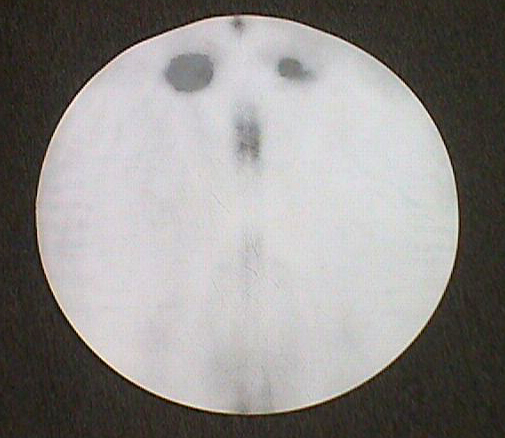
Regarding translucent spots on white heads: Most of the calfskin heads we get (whether Pakistani, American, or Irish) have an occasional translucent spot in an otherwise white head. The most commonly seen example of this is when we have two spots on either side of a visable grain as in the photo below. The grain is where the spine or backbone of the animal was, the two spots are where the hip bones were. The skin was all translucent at the beginning of the tanning process. It was stretched tight while damp, and as it dried, the small fibers separate in a process referred to as “breaking white.” If the skin had a spot like the hip bone “bump,” it does not get stretched as tight as the rest of the skin and therefore does not break white. I once asked Mr. Stephen Palansky about the spots and he assured me that these are not defects, but an unavoidable natural feature of calfskin heads. I have since sold hundreds of skin heads and can say that of the dozen or so broken heads that we have considered defective over the last few years, not one of them showed a break or tear at one of these translucent spots. (More often, a head returned to us with a tear is one of the heads with no visible grain, indicating it was taken from a side of the skin.) I was discussing this with my good friend and customer Wes Aardahl recently and he shared with me that he used to buy calf heads from Stan at Pro Drum in Hollywood who advised Wes to always try to get a head showing the backbone grain as shown in this photo, and to play on the translucent area which he referred to as the “sweet spot.” (Stan told Wes that Jake Hanna referred to that as the sweet spot.)
It is, of course, beyond our control to specify grain or lack thereof, but we do try to accomodate the requests of our customers when we select skins from our inventory and I certainly understand when a customer requests a uniformly white head..


Copyright 2006 Rebeats©
P.O. Box 6
219 Prospect St
Alma, Michigan 48801

Web Site Design VSD